


Listen to the article
Astronaut Crew for Historic Lunar Mission Arrives at Kennedy Space Center
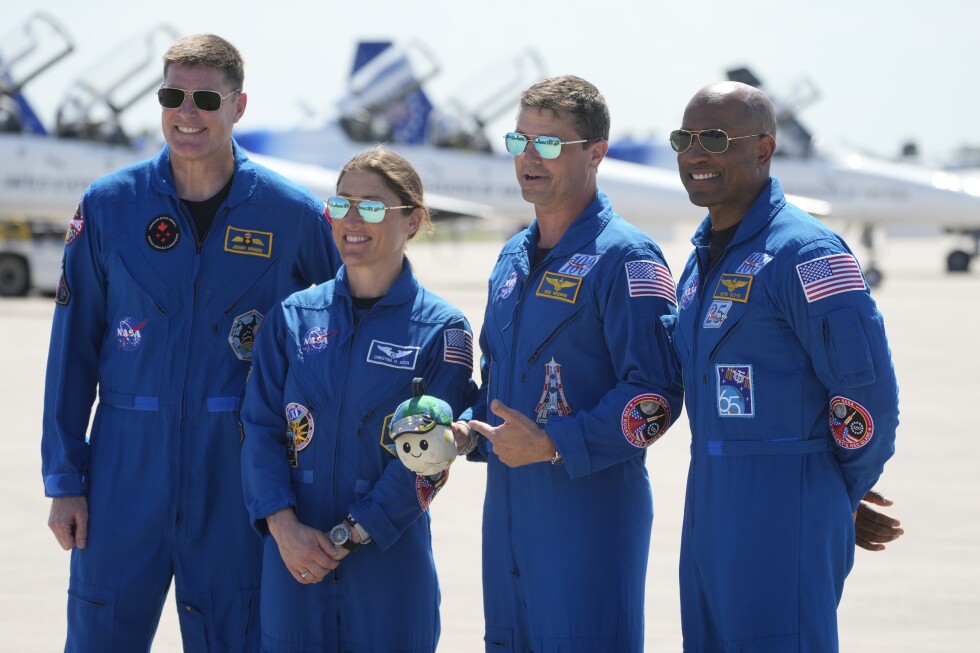
The four astronauts slated to become the first humans to travel around the moon in more than half a century arrived at Kennedy Space Center in Florida on Friday, bringing them one step closer to their historic launch.
Artemis II Commander Reid Wiseman led his crew from Houston to the launch site where their towering Space Launch System (SLS) rocket stands ready on the launchpad. “Hey, let’s go to the moon!” Wiseman shouted to the welcoming crowd. “I think the nation and the world have been waiting a long time to do this again.”
The crew includes NASA astronauts Victor Glover and Christina Koch, along with Jeremy Hansen of the Canadian Space Agency, marking the first time a non-American will journey beyond Earth orbit. Hansen added his own enthusiasm in both English and French, exclaiming, “We’re all fired up to go do this. So ‘Allons-y!'”
Their arrival comes after months of technical challenges that pushed back the original timeline. Fuel leaks and other rocket issues forced NASA to conduct two separate rollouts of the massive SLS rocket from its hangar to the launchpad, causing a two-month delay.
NASA has targeted as early as Wednesday, April 1, for liftoff, with a launch window extending through April 6. If the mission doesn’t launch during this period, teams would need to stand down for nearly a month before the next opportunity.
Despite the optimistic timeline, Commander Wiseman acknowledged the unpredictable nature of spaceflight. “There’s no guarantee we will launch in early April as planned,” he cautioned, noting it could slip to May or even June. The SLS rocket has only flown once before – an uncrewed test mission in 2022.
Glover expressed the team’s patience with the process: “That’s this business. It will go when the engines light at T-zero, and we totally understand that.”
The mission represents a pivotal moment for NASA’s Artemis program, designed to return humans to the lunar surface and eventually establish a permanent presence on the moon. During their 10-day mission, the astronauts will travel around the moon in the Orion spacecraft before returning to Earth with a splashdown in the Pacific Ocean.
While they won’t land on the lunar surface, their journey will mark the farthest humans have traveled from Earth since Apollo 17 in December 1972. The mission will test critical life support systems and spacecraft performance ahead of future lunar landing missions.
The crew was greeted by NASA’s new administrator Jared Isaacman and Canadian Space Agency President Lisa Campbell, along with numerous NASA officials and more than 100 journalists. Earlier in the week, Isaacman outlined an updated timeline for NASA’s ambitious lunar program, which includes a 2027 lunar lander demonstration in Earth orbit followed by one or possibly two crewed lunar landings in 2028.
Koch expressed enthusiasm for the refined timeline, saying, “We’re in a relay race… and if nothing else this just fired us up for that all the more.”
The Artemis program represents NASA’s most significant human exploration initiative in decades, with goals that extend beyond the moon to eventual human missions to Mars. It also marks a new era of international cooperation in deep space exploration, with contributions from the European Space Agency, Japan Aerospace Exploration Agency, and the Canadian Space Agency.
As final preparations continue for next week’s potential launch, the mission stands as a powerful symbol of humanity’s return to deep space exploration after a half-century hiatus from lunar missions.
Fact Checker
Verify the accuracy of this article using The Disinformation Commission analysis and real-time sources.

4 Comments
Kudos to the Artemis II astronauts for their bravery and commitment. Returning humans to the Moon is an incredible feat, especially given the long gap since the Apollo program. I hope this mission sparks renewed global interest in space exploration.
Exciting to see the Artemis II crew arrive in Florida! This mission to orbit the Moon will be a major milestone and I’m looking forward to following their journey. It’s great that Canada is represented too – a truly international endeavor.
The technical challenges in getting the SLS rocket ready must have been frustrating, but it’s good that NASA is taking the time to ensure everything is safe and ready to go. Can’t wait to see the crew lift off!
Returning to the Moon is a major achievement, especially after so many decades. The Artemis II mission will no doubt inspire the next generation of space explorers. Can’t wait to see the crew’s scientific discoveries and the breathtaking images they’ll capture.