


Listen to the article
Nine-year-old Logan Coyle stood at his hospital window, holding up a handmade sign reading “Proud of My Primaries” as thousands of nurses picketed outside. The poignant moment provided encouragement to Morgan Bieler, one of Logan’s primary nurses, who was among the 15,000 healthcare workers who walked off the job last month in New York City’s largest nursing strike in decades.
Nearly a month later, more than 4,000 nurses in the NewYork-Presbyterian system remain on the picket line, the last holdouts in a bitter labor dispute that has affected some of the city’s most prestigious medical institutions.
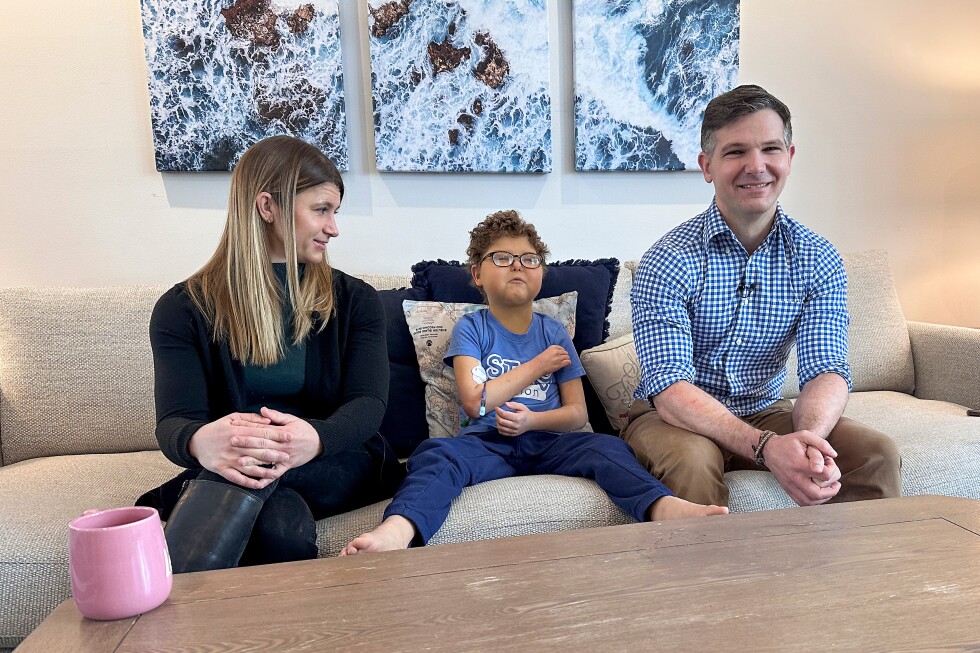
“Every single day that this drags on is a severe impact to us,” said Jeff Coyle, Logan’s father. “We are the collateral damage of this strike.”
Logan, who has been battling advanced liver cancer for two years, has endured chemotherapy and a complex triple transplant of a liver, pancreas, and small intestine. He recently returned home after having a tumor removed near his spine, but his family says the quality of care during this hospital stay was noticeably different without his regular nurses.
“I wouldn’t want to be back there for another month without them,” Logan said from his family’s home in Port Washington, Long Island, about 25 miles from Manhattan. “I would feel more safer if they were all back.”
Rebecca Coyle, Logan’s mother, reports spending more sleepless nights at her son’s bedside than during previous hospital stays because of staffing inconsistencies. Temporary replacement nurses cycled in and out every few days, bringing varying levels of experience.
“I was just constantly up, checking to make sure that something was running appropriately or waiting for a medicine to arrive or waiting for fluids to arrive or a blood product,” she said. “I felt like I had to be so vigilant.”
Progress toward resolution appears to be accelerating for some hospitals. On Monday, the nurses’ union reached tentative deals with two other major systems, Mount Sinai and Montefiore. If approved in membership votes this week, these three-year agreements would see unionized nurses at those hospitals return to work by Saturday.
However, negotiations at NewYork-Presbyterian have moved more slowly. The hospital maintains it has agreed to a mediator’s proposal that includes many union demands, such as pay raises, preserved pensions, maintained health benefits, and increased staffing levels.
The union counters that the strike remains necessary. As of Tuesday, no plans to resume negotiations had been announced.
At the heart of the dispute are fundamental disagreements about compensation and working conditions. Hospital administrators claim the union’s demands are excessive, noting that unionized nurses already average $162,000 to $165,000 annually, not including benefits. Union representatives point to the millions earned by top hospital executives in response.
Jeff Coyle expressed frustration that hospital administrators haven’t negotiated more aggressively, instead opting to hire thousands of temporary nurses to fill staffing gaps week after week.
“If we have to be there, each side to these contract negotiators should also be there, working as hard as they can to end this as quickly as they can,” he said.
NewYork-Presbyterian has consistently maintained they remain ready to negotiate when called upon, insisting their operations continue to run smoothly despite the strike. The hospital claims organ transplants and other complex procedures have largely continued uninterrupted.
Bieler, however, worries daily about her long-term patients still at the hospital. She reports that bone marrow transplants and chemotherapy treatments have been delayed or canceled entirely for some patients due to staffing challenges.
“We’re not the only pawns in this,” Bieler said. “They’re playing with children’s lives, and I can’t imagine how frustrating that is for our community.”
The strike has highlighted the complex dynamics between healthcare institutions, their staff, and the patients caught in the middle of labor disputes. For families like the Coyles, who also have Logan’s twin sister Riley at home, the prolonged negotiation has added another layer of stress to an already challenging medical journey.
Despite the difficulties, Bieler says caring for Logan, whom she describes as “upbeat” and “endlessly positive,” has changed her outlook on life.
“He’s always the best version of himself, and he faces everything with a smile,” she said. “I don’t think I would be the nurse, let alone the person I am today, without him and his family.”
Fact Checker
Verify the accuracy of this article using The Disinformation Commission analysis and real-time sources.

7 Comments
This is a difficult and complex situation. On one hand, nurses deserve fair pay and working conditions. On the other, patients like Logan should not be caught in the crossfire. I hope all parties can come to a reasonable compromise quickly.
Heartbreaking situation for this young cancer patient and his family. The nursing strike is clearly having a major impact on the quality of care. I hope they can resolve this labor dispute soon for the sake of vulnerable patients like Logan.
The plight of Logan and his family really underscores the human cost of this prolonged nursing strike. I can’t imagine how stressful and worrying this must be for them. Wishing Logan all the best in his recovery during this challenging time.
This is a difficult situation with no easy answers. Nurses deserve fair compensation and working conditions, but patients like Logan should not be collateral damage. I hope all parties can come together quickly to find a solution.
The human stories like Logan’s really put a face to the consequences of this prolonged nursing strike. I sincerely hope the hospital and union can find common ground to resolve this dispute and restore quality care for patients.
This is a heartbreaking situation all around. The nursing strike is clearly taking a toll on vulnerable patients like Logan. I hope the two sides can come to an agreement soon so that critical care is not further disrupted.
Kudos to Logan for his resilience and positive spirit. It’s admirable that he’s trying to encourage his nurses on the picket line. I hope the hospital and union can find a solution that balances the needs of staff and patients.