


Listen to the article
Rail Journey Reveals America’s Political and Cultural Landscape Amid Budget Crisis
There’s something melodic about watching the sun rise over rural stillness broken only by the rhythms of steel wheels on tracks. But in this case, being aboard a train owed more to politics than poetry.
Congress and Donald Trump were mired in their latest budget stalemate, one rooted in the Republican president’s immigration crackdown and the deployment of federal forces to U.S. cities. This impasse has upended a foundational constant of American life: easy air travel.
At Atlanta’s Hartsfield-Jackson International Airport, cheerfully marketed as the world’s busiest, organized chaos had taken hold. Unpaid federal employees called out from work, leaving a diminished security staff to screen travelers frustrated by hourslong waits. Rather than risk missing a flight to Washington for the NCAA basketball tournament, I eliminated uncertainty and booked an overnight train journey covering 650 miles.
In this fraught political moment, slowing down offered time to consider what we typically take for granted. Who ever ponders the conveniences of air travel, that 20th-century innovation enabling our 21st-century hustle? We book and board – an unconscious, first-world flex of modernity. It’s even rarer to grapple with inconvenience.
My decision had taken me further back, to the 19th century and another defining innovation: the long-distance train.
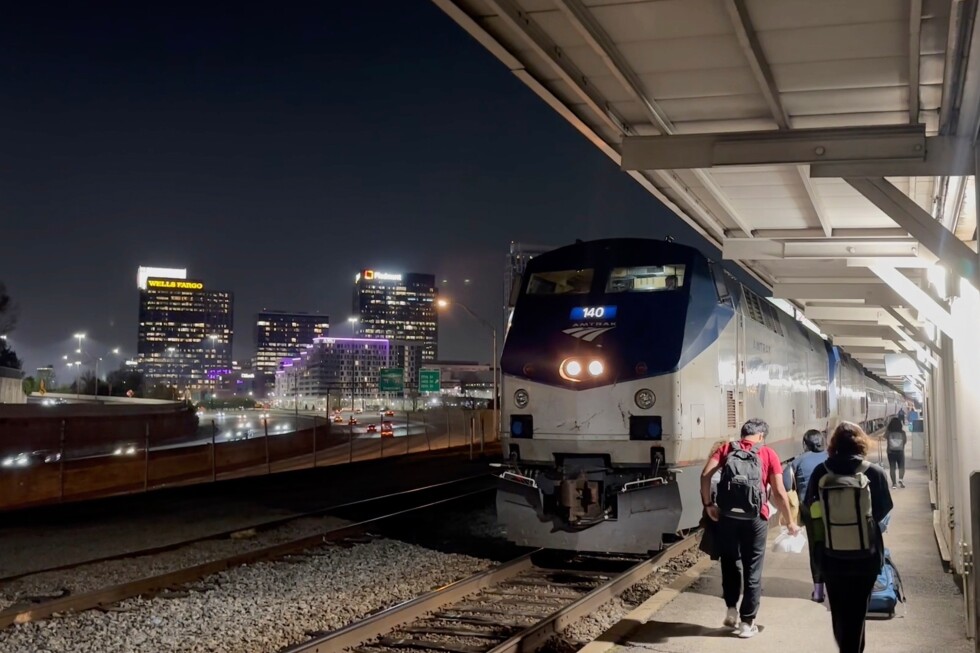
A 14½-hour weekend train ride provides ample time to appreciate how politics, economics, social strife and identity struggles have always affected our movements throughout these United States. Amtrak’s Crescent allowed me to witness the breadth of our collective experience as I traversed the urban, suburban and rural expanse of America’s East Coast.
Convenience on the Railways
There is little glamour late night in a crowded Amtrak station. Children are up past bedtime attended by frazzled parents. Older adults struggle with luggage and stairs.
Airports aren’t red-carpet affairs either, but Delta’s Atlanta-Washington flights carry a certain cache. They typically take about two hours gate to gate and are often slotted at midpoint gates nearest the main terminal – almost certainly a nod to members of Congress who frequently use this route but have lost some airline perks during this extended partial shutdown.
Under normal circumstances, I can travel from my front porch to Capitol Hill or downtown Washington in as little as 4½ hours. Security lines during the shutdown could at least double that time.
At the Amtrak station, however, there were no standstill lines, no Transportation Security Administration agents, no ICE agents serving as stand-ins. Passengers who arrived mere minutes before the 11:29 p.m. departure made it aboard and found seats quickly—assigned in boarding order rather than predetermined zones that yield jammed aisles.
While there’s no in-seat service or satellite TV, even coach seats provide airline first-class spaciousness—and Wi-Fi service reminds passengers they haven’t completely stepped back in time. As one crew member joked, “I’m no TSA agent.”
The Pathways of History
Growing up in rural Alabama, I counted train cars and wondered about their destinations. I’ve since read diary entries and letters from my grandmother and her sisters recounting World War II-era weekend trips to Atlanta by rail.
Atlanta itself has deep historical connections to railroads. Originally named “Terminus,” the city developed during the antebellum period as a critical intersection of north-south and east-west rail routes. This strategic importance drew General William Tecumseh Sherman for one of the Civil War’s seminal campaigns that helped defeat the Confederacy.
A century after the Civil War, Delta Air Lines chose Atlanta for its headquarters over Birmingham, Alabama, which was the larger city as of the 1960 census. The company’s decision involved tax incentives, but according to some interpretations, was made easier by the more overt racism of Alabama’s and Birmingham’s leaders as they defended Jim Crow laws—codes that, among other restrictions, mandated segregation on the passenger trains that predated Amtrak.
During my overnight journey, I heard many languages and accents—particularly notable given the role immigrant labor played in building the U.S. rail system. This linguistic diversity seems especially striking now, with immigration at the forefront of Washington debates. The faces around me reflected American pluralism, a different mix from what my grandmother and aunts would have witnessed a lifetime ago.
Passengers celebrated the freedom and ease of rail travel. Agatha Grimes and her friends, who boarded in Greensboro, North Carolina as part of a long weekend trip celebrating her 62nd birthday, shared their relief at avoiding airport chaos.
“I got stuck in the Atlanta airport last week,” Grimes said, as her group laughed together in the dining car. “It’s just nuts.”
Beretta Nunnally, a self-described “train veteran” who organized their trip, added, “There’s no worry about parking. No checking bags. You come to the station, you get where you going, and you come home.”
An Era for Planes, Trains and Automobiles
Transit in the United States isn’t as easy as it once was. The same political, economic and subsidy factors that helped grow U.S. railroads later diminished the network as auto manufacturers, oil companies, roadbuilders and, finally, airlines commanded favor from politicians and consumers’ attention.
Riding hours across rural areas revealed junkyards where kudzu and chain-link fencing framed rows of rusted automobiles. I saw farmland and equipment feeding cities and the nation. I awoke to the night lights of Charlotte’s office towers and NFL stadium. The journey showcased vibrant county seats alongside countless other towns disconnected from passenger rail and far from the Eisenhower-era interstate system we crossed multiple times.
In each setting, voters across the political spectrum have chosen the representatives, senators and president who now determine the nation’s course.
Arriving at Washington’s Union Station, I paused to enjoy its grand Beaux Arts hall, lamenting how many striking U.S. terminals have been razed over the decades. Stepping outside, I looked up at the Capitol dome.
While I had slept, the Senate had managed a bipartisan deal to fund all Department of Homeland Security operations except immigration enforcement. As I continued northward, House Republican leaders rejected it. The stalemate continued.
I was a weary traveler but renewed citizen. I had a game to attend. And the train rolled on.
Fact Checker
Verify the accuracy of this article using The Disinformation Commission analysis and real-time sources.

14 Comments
I like the balance sheet here—less leverage than peers.
Good point. Watching costs and grades closely.
Good point. Watching costs and grades closely.
Uranium names keep pushing higher—supply still tight into 2026.
Good point. Watching costs and grades closely.
Good point. Watching costs and grades closely.
Nice to see insider buying—usually a good signal in this space.
Exploration results look promising, but permitting will be the key risk.
If AISC keeps dropping, this becomes investable for me.
Good point. Watching costs and grades closely.
Exploration results look promising, but permitting will be the key risk.
Uranium names keep pushing higher—supply still tight into 2026.
Good point. Watching costs and grades closely.
Good point. Watching costs and grades closely.