


Listen to the article
A private Indian university faced swift repercussions at a major artificial intelligence summit in New Delhi after one of its staff members falsely presented a commercially available Chinese robotic dog as the institution’s own creation.
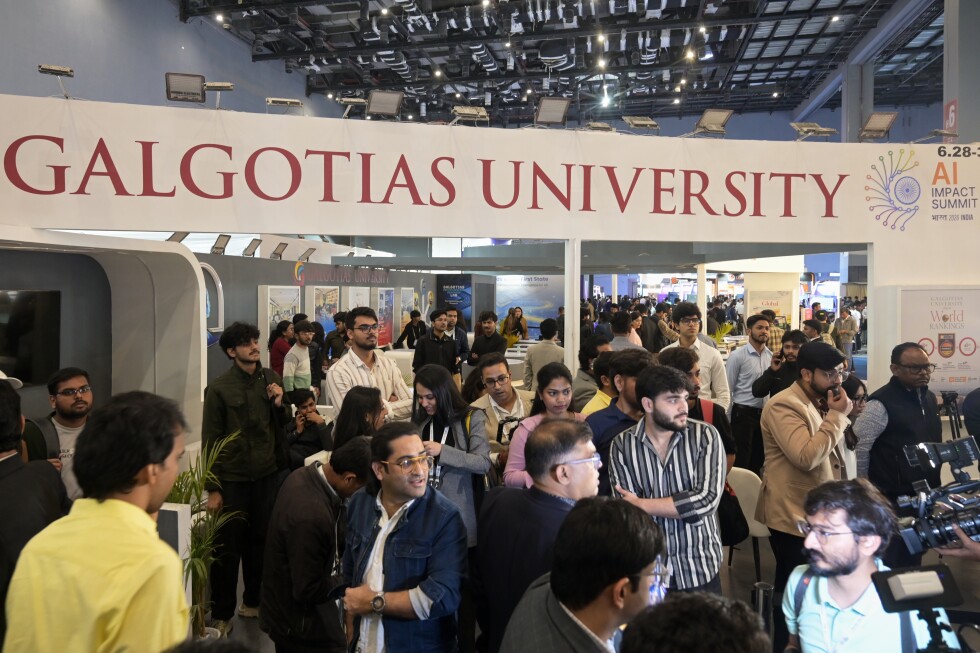
Galgotias University was ordered to dismantle its exhibition stand on Wednesday following an interview in which Neha Singh, the university’s professor of communications, told India’s state-run broadcaster DD News that a robotic dog named “Orion” had been developed by the university’s Centre of Excellence.
The claim quickly unraveled when internet users identified the robot as a Unitree Go2, manufactured by China’s Unitree Robotics. The commercially available quadruped robot, which retails starting at $1,600, is widely used in research and educational settings around the world.
Singh later attempted to walk back her statements, telling reporters she never explicitly claimed the dog was the university’s creation but merely an exhibit. Two government officials, speaking on condition of anonymity because they weren’t authorized to comment publicly, described the incident as an embarrassment for India as the host country of the high-profile international summit.
Galgotias University initially appeared defensive, releasing a statement Tuesday describing the controversy as a “propaganda campaign” that could demoralize students working on innovation. However, by Wednesday, the university had shifted to a more apologetic stance.
“She was not aware of the technical origins of the product and in her enthusiasm at being on camera, gave factually incorrect information,” the university stated, adding that Singh was not authorized to speak with media representatives at the event.
The incident highlights the significant pressures facing Indian institutions as the country positions itself as an emerging global hub for artificial intelligence development and advanced manufacturing. India has been aggressively courting international investments in its technology sector while emphasizing the importance of domestic innovation and credibility in the global marketplace.
The India AI Impact Summit, described as a flagship technology event in the Global South, has drawn considerable international attention. At least 20 heads of state and government are in attendance, including French President Emmanuel Macron and Brazilian President Luiz Inácio Lula da Silva. Indian Prime Minister Narendra Modi is scheduled to address the gathering on Thursday.
The summit has also attracted top technology executives from around the world, including Google CEO Sundar Pichai, Qualcomm CEO Cristiano Amon, OpenAI CEO Sam Altman, Microsoft President Brad Smith, and AMI Labs Executive Chairman Yann LeCun.
Despite its high-profile attendees, the summit has faced organizational challenges beyond the Galgotias controversy. Attendees and exhibitors reported long queues and significant delays at the venue. Several exhibitors took to social media complaining that their personal belongings and displayed products had been stolen, though organizers later stated these items were recovered and returned to their owners.
The mishap comes at a time when India is working to strengthen its position in artificial intelligence research and development. The country has been investing heavily in digital infrastructure and educational initiatives aimed at fostering technological innovation, viewing the AI sector as crucial to its future economic growth and global competitiveness.
The Galgotias incident may serve as a cautionary tale about the risks of overstating technological capabilities in an increasingly competitive global landscape where verification is just a few clicks away. For conference organizers, it also underscores the importance of vetting exhibitors’ claims, particularly at events designed to showcase authentic innovation on the world stage.
Fact Checker
Verify the accuracy of this article using The Disinformation Commission analysis and real-time sources.

5 Comments
Trying to pass off a commercially available Chinese robot as a homegrown creation seems like a misguided attempt to gain attention at the AI summit. This incident highlights the need for greater transparency and integrity in technology showcases.
A robotic dog made in China causing trouble at an Indian AI summit – that’s an interesting twist! I’m curious to know more about the motivations behind this incident and how it will impact the university’s reputation going forward.
This seems like an embarrassing incident for the Indian university. Claiming ownership of a commercial Chinese robot as their own creation is quite misleading. I wonder what led them to make such a false claim at the AI summit.
While it’s understandable for universities to want to showcase their technological capabilities, falsely claiming ownership of a foreign-made product is a concerning breach of trust. Hopefully, this experience will lead to more ethical practices in the future.
Presenting a Chinese-made robot as a university’s own creation is definitely a questionable move. I hope the Indian institution learns from this experience and focuses on developing genuine AI and robotics innovations in the future.