


Listen to the article
In the heart of Harlem, a new thrift shop is challenging fashion norms and creating a sustainable haven for modest dressers. Kadjahtou Balde, the founder of Modify Thrift on Malcolm X Boulevard, has transformed her father’s struggling gift shop into a community space celebrating both Islamic values and environmental consciousness.
“My dad told me that he was tired,” Balde explained about the store’s origins. “I decided that I want to help him, but I want to do it in a way that aligns with my values: Islam and sustainability.”
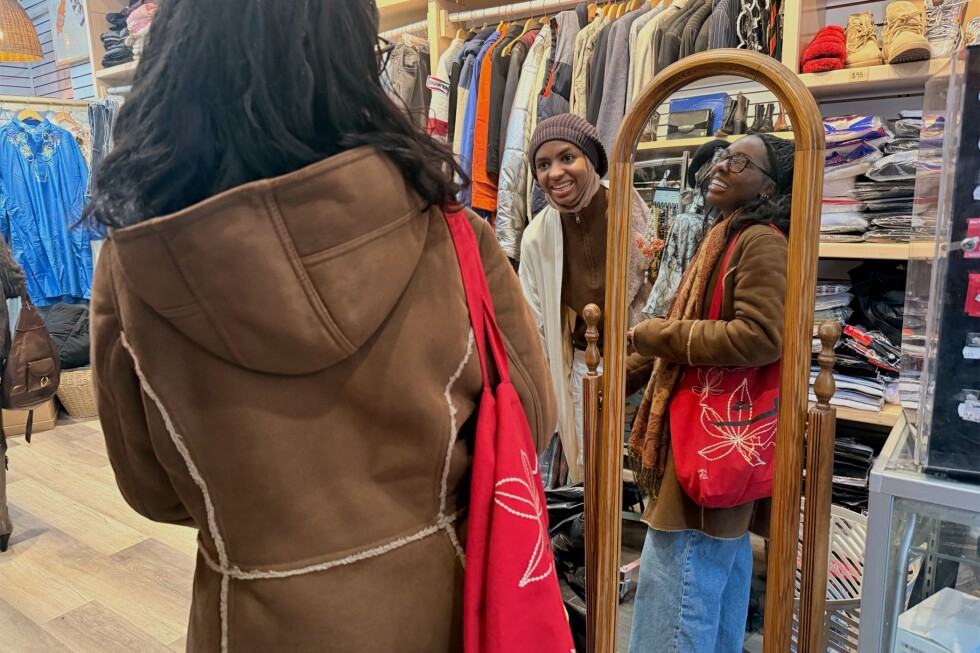
Since opening last May, Modify Thrift has quickly become more than just a retail space. The shop specializes in curating modest fashion pieces that are both stylish and sustainable, addressing a gap in New York City’s otherwise abundant thrift scene. Despite being an avid thrifter herself, Balde had struggled to find pieces that accommodated her needs as a fashion-conscious Muslim woman who dresses modestly.
The store’s collection features everything from silk skirts with traditional Palestinian embroidery to intricately detailed abayas—the loose, robe-like garments many Muslim women wear. These pieces challenge prevailing stereotypes about modest fashion being boring or oppressive.
“Muslim women are some of the most fashionable people out there,” Balde noted, addressing how the secular world’s fixation on Muslim women’s clothing, especially head coverings, has fueled discriminatory policies in Europe and sparked debates about women’s rights and Islamophobia in the United States.
In post-9/11 New York, where visibly Muslim individuals often fear hate crimes, Balde observed that some hijab-wearing women use fashion to blend in. Her store aims to empower them to express themselves authentically while adhering to their values.
“How do we break that barrier and make it so that it is fun, it’s trendy to be a Muslim woman—to know how to layer, how to style, how to dress in a way that represents your values in the most stylish way possible?” Balde asked.
While the international modest fashion industry has expanded significantly in recent years, Balde criticized its reliance on fast-fashion brands with questionable production ethics. For her, running a thrift store is not just business—it’s a form of worship that fulfills the Islamic principle of environmental stewardship.
“As a Muslim, I know for sure that I cannot be a Muslim who consumes fast fashion only,” said Balde, who also leads Faithfully Sustainable, the city’s first Muslim environmental justice organization. “We have to be people who care for the planet and for our neighbor.”
This philosophy resonates with customers like Hafeezat Bishi, a 25-year-old Manhattan resident who is consciously cultivating a wardrobe of high-quality materials. “Going into Modify really helps me re-center my purpose,” Bishi said. “It fuels my justice-based faith, and at the end of the day, I feel like I’m doing something not just for myself, but the greater good of the community and the Earth.”
Other shoppers, like Harlem resident Ella Smith, are drawn by more practical considerations such as rising costs and limited affordable options. “I want to see if I can find something no one else has—catch a good, great bargain for a few bucks,” Smith explained.
The shop’s inventory comes primarily from community donations, supplemented by purchased items and consignment pieces. Nabiha Ali, the Assistant Operations Manager, carefully reviews all donations, prioritizing natural materials like wool and cotton before setting prices.
Ali regularly fields questions about what constitutes modest clothing. She explains that while modesty typically involves looser styles covering limbs and necklines, the store encourages creative layering that can transform less modest individual pieces into appropriate outfits.
“Working at Modify has taught me that no two Muslim women look the same,” Ali reflected. “It’s just really personal and individual, and everyone’s on a different point in their journey.”
Community engagement remains central to Balde’s vision. She recognizes Harlem’s rich heritage as a fashion and cultural capital shaped by African American creativity. “Harlem has an insane crowd of people who just have the most insane style,” she observed, noting how residents dress up fashionably for Sunday church services.
Before renovating the store, Balde introduced herself to neighbors, following her father’s example of relationship-building since he first arrived in Harlem as a street vendor in 2001. The renovation itself became a bonding experience, as Balde and her father worked side-by-side just three months after she gave birth.
“I was just enjoying moments I never had as a kid because he was always working,” she recalled. “He did the hard work so that we could actually live out our dreams.”
Modify Thrift honors her father’s dedication in a neighborhood that faces ongoing gentrification pressures on longtime small businesses. Looking ahead, Balde hopes to expand the concept, establishing immigrant-run modest thrift stores in every New York City borough.
“I think business should exist as a way to benefit a community,” she said, “and not just to profit off of community.”
Fact Checker
Verify the accuracy of this article using The Disinformation Commission analysis and real-time sources.

10 Comments
It’s great to see a business taking an intersectional approach to addressing the needs of fashion-conscious Muslim women. Promoting both Islamic values and environmental consciousness is a laudable aim.
Agreed. Combining cultural, religious, and sustainability considerations creates a truly holistic business model that could have far-reaching impacts.
It’s great to see a business blending faith, fashion, and sustainability. Thrift shops can play an important role in promoting eco-friendly and inclusive clothing options.
As an avid thrifter myself, I know how challenging it can be to find pieces that meet specific cultural or religious needs. This shop seems to be addressing an important gap in the thrift market.
Absolutely. Providing access to modest, ethically-sourced fashion is a valuable service that can empower diverse communities.
Modest fashion is an underserved market, so this shop seems to be filling a valuable niche. I’m curious to learn more about the traditional Palestinian embroidery and other unique pieces they offer.
That’s a good point. Showcasing traditional cultural designs and techniques could help raise awareness and appreciation for diverse fashion traditions.
Transforming a struggling gift shop into a community space that celebrates Islamic values and sustainability is an admirable goal. I hope this business model proves successful and inspires similar initiatives.
Blending faith, fashion, and sustainability is a unique and intriguing concept. I’m curious to see how this business evolves and potentially influences the broader thrift and modest fashion landscapes.
This shop seems like a wonderful example of how entrepreneurs can leverage their personal experiences and values to fill unmet market needs. I look forward to seeing how Modify Thrift continues to grow and innovate.